

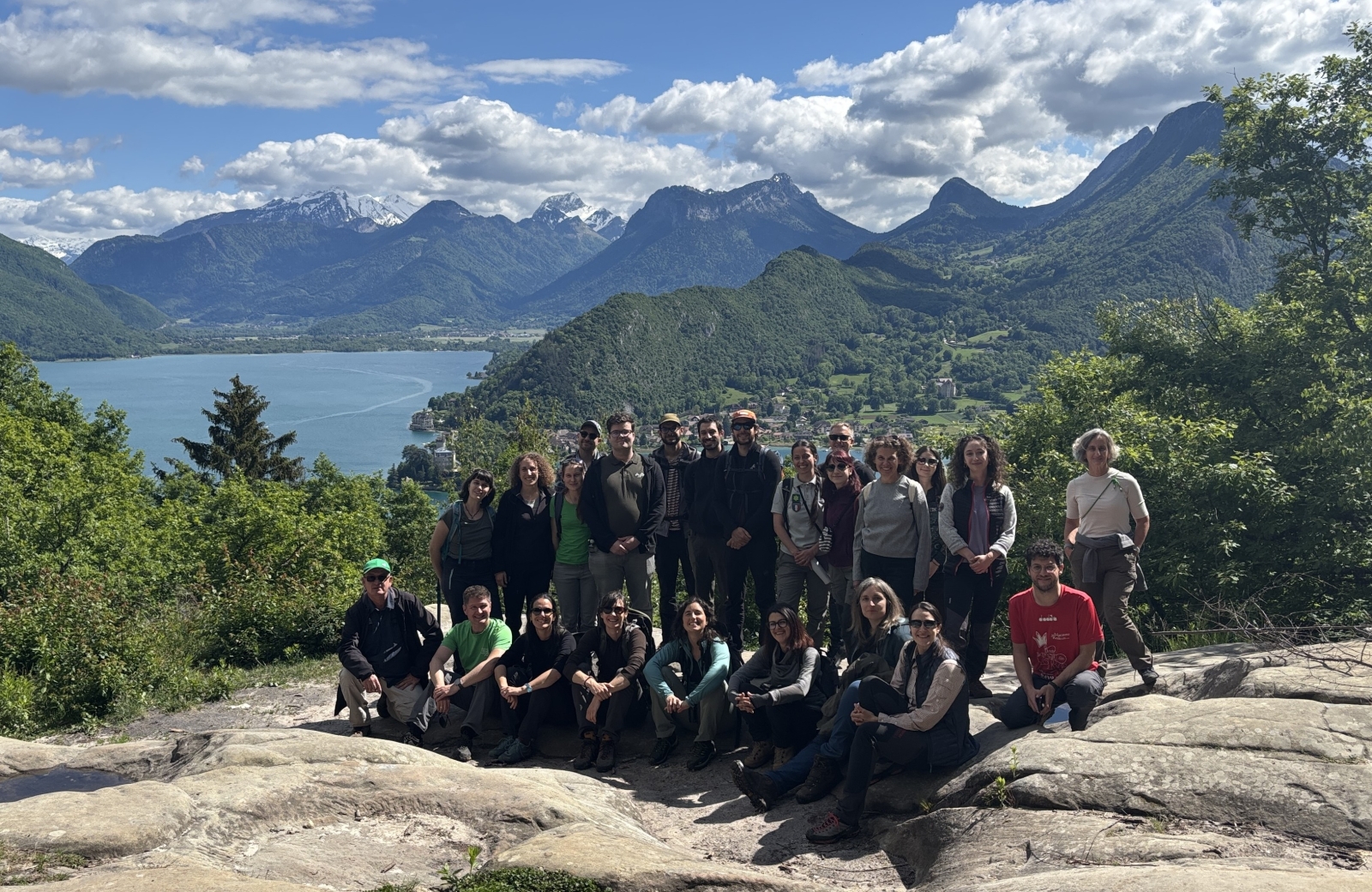

The AlpsLife project (INTERREG Alpine Space) journey continued with visits to the pilot sites. The third consortium meeting took place on 12–13 May 2016 in Annecy, where the partnership was hosted at the characteristic Manoir de Novel, headquarters of ASTERS.
After one and a half years from the start of the project, the first results are becoming increasingly tangible, fostering concrete discussions among the partners. In particular, the Alpine Protected Areas played a central role during the meeting, focusing on two main topics:
- Verifying, at the local scale, the accuracy and practical usefulness of the remotely sensed indicators and maps developed at Alpine scale during the project, especially those related to plant and bird richness.
- Discussing the development of a common platform aimed at gathering biodiversity data collected by the APAs, based on the shared monitoring protocols investigated throughout the project, and enabling comparisons of trends among protected areas.
This second topic, that represent the basis for an early warning system forthe biodiveristy in the Alps, generated especially lively discussions, highlighting the intention of the partners to deliver a practical and long-term result by the end of the project.
During the meeting, the partners also discussed the possibility of creating a common framework for responding to detected changes in biodiversity data, linking the future platform to management measures. Additional discussions focused on strategies to improve data harmonization and on the development of a coordinated communication strategy across the different Work Packages. Although many challenges still lie ahead, the partnership is becoming increasingly motivated and cohesive in pursuing the project’s objectives.
The field excursion provided an opportunity to observe monitoring activities and related challenges more closely in the beautiful Réserve Naturelle du Roc de Chère. The reserve manager guided the partners through a landscape rich in habitats, where lake shores, cliffs, forests, and peatlands coexist in a unique natural mosaic. During the visit, the reserve manager explained the different monitoring schemes used to study the many animal and plant species living in such a distinctive environment. But, while restoration activities are better able to attract funding because their results are immediately visible, securing adequate resources for long-term monitoring strategies remains more difficult. Yet long-term monitoring is essential, as it forms the basis of effective management plans in protected areas. For this reason, establishing a framework that allows biodiversity data to be more easily compared across different areas remains one of the project’s key goals.
The next stop on the AlpsLife journey will be the Berchtesgaden National Park (Germany).
For more information about the project: https://www.alpine-space.eu/project/alpslife/
The AlpsLife project is co-funded by the European Union through the Interreg Alpine Space programme, which supports cross-border cooperation projects between seven Alpine countries.
© photo: EURAC / Mathilde Maure